Circular Economy
The Horizon Strategic Plan focuses on the development, construction and operation of sustainable infrastructure. Aligned with this vision, Ferrovial’s Sustainability Strategy addresses society’s main environmental challenges in the areas of climate change, biodiversity, circular economy and water, integrating these priorities across the Group’s business activities to effectively manage environmental risks and support long term asset performance.
As a reflection of these commitments, Ferrovial approved its Circular Economy Plan, which is implemented across Ferrovial construction projects and, where applicable and subject to project scope and local requirements, across buildings and infrastructure assets under the company’s operational control. The Plan reinforces Ferrovial’s determination to deliver services and infrastructure that:
- Increase waste reuse and recycling.
- Promote the efficient use of materials, including recycled materials where technically and economically feasible.
- Improve water efficiency and responsible water management.
- Support the transition towards more energy efficient and resilient economic models, contributing to long term decarbonization efforts.
- Reduce Ferrovial’s environmental footprint and that of its users and customers.
To achieve these objectives, Ferrovial works to progressively embed circular economy principles across its key processes, products and services, in line with recognized frameworks such as the waste hierarchy and broader circular economy principles.
Prioritizing waste reuse and recycling as a resource
Waste
Improving energy efficiency and consumption of renewable electricity
Energy
Increasing efficiency in water consumption and promoting water reuse and recycling
Water
Focus on the incorporation of recycled materials in our processes
Materials
Waste Prevention and Circular Design
Waste prevention is systematically addressed from the early design and planning stages of projects, where design responsibilities are under Ferrovial’s control. These measures include material optimization, reuse of excavated materials, selection of recyclable construction solutions, and design approaches that facilitate deconstruction and material recovery at end of life, with the objective of minimizing waste generation and maximizing resource efficiency throughout the asset life cycle.
Waste Management and Performance Monitoring
Ferrovial integrates waste management requirements into construction contracts, as applicable, including obligations related to waste segregation, traceability, recovery targets and reporting by contractors and subcontractors. These requirements are aligned with the Group’s circular economy objectives and are applied consistently across construction activities.
In addition to reporting absolute waste volumes, Ferrovial systematically monitors construction and demolition waste (CDW) recovery performance through normalized indicators at project and business unit level, based on data availability and project typology. These indicators are reviewed annually and are used to:
- Support regulatory sustainability disclosures, including EU Taxonomy reporting, ensuring alignment at contract and activity level.
- Enable consistent benchmarking across construction activities.
- Drive continuous improvement in waste recovery and circular performance.
Circular Economy in Practice
Examples of Ferrovial’s circular economy and waste management practices include:
- Recovery of sewage sludge and the evaluation of technologies to reduce sludge volumes, such as hydrothermal carbonization.
- Capture and use of biogas generated in water treatment plants, for thermal applications and electricity generation for self‑consumption.
- Development of long‑lasting pavements through improved bitumen and asphalt binders, extending asset life and reducing material consumption.
- Implementation of water efficiency measures in building renovation works, including low‑consumption taps and sanitary installations.
Circular Economy
Highlighted Projects
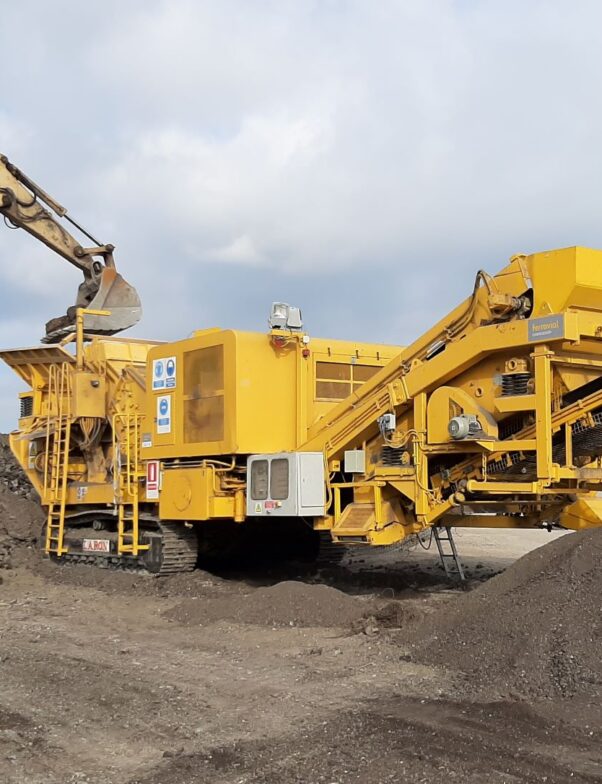
An example of circular economy
Ferrovial Construction reuses up to 100% of the excavated earth and 98% of the materials recovered from demolitions at Barajas.